Introduction: A Universal Problem Requires Systematic Thinking
Every system exists because of a need.
In engineering, we begin with a problem statement, decompose it into requirements, identify constraints, evaluate alternatives, and select the solution that best satisfies the system’s purpose. Without clarity of need, we build the wrong system. Without specific requirements, we create an imperfect system often missing the mark entirely. Without proper constraints, we create false expectations. Without disciplined analysis, we choose incomplete solutions.
Salvation is not merely a theological abstraction; it addresses the most universal human need. If sin is the fundamental failure condition of humanity, then salvation from sin is the required corrective system.
Rather than approaching salvation sentimentally (see Jeremiah 17:9), we will examine it systematically.
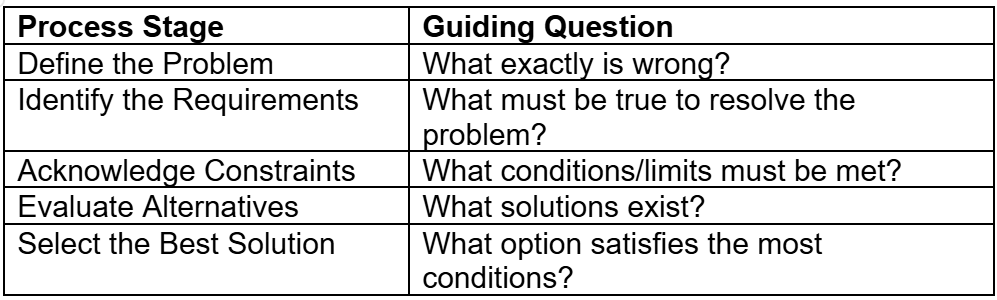
Only then can we identify the solution that truly meets the need.
Need Statement: Salvation from Sin
Scripture makes the problem unambiguous. Paul tells us in Romans who has sinned and what the results are:
For all have sinned and fall short of the glory of God.
Romans 3:23
The wages of sin is death.
Romans 6:23
In Isaiah, we see whom we have sinned against:
…Your iniquities have made a separation between you and your God, and your sins have hidden his face from you so that he does not hear.
Isaiah 59:2
These verses tell us something significant: human’s universal need is salvation from sin.
But what does that mean systematically?
Decomposing the Need
The problem of sin creates several cascading effects:
Separation from God (Isaiah 59:2)
Moral corruption (Proverbs 14:34; Galatians 6:8)
Inability to self-correct (Psalm 19:12; Proverbs 14:12)
Judgment and death (Romans 2:5-6, 6:23)
Therefore, the system requirement is not merely moral improvement. It is reconciliation, restoration, and redemption. In other words, we need to be saved. We do not need incremental adjustment. We need rescue.
Requirements
If salvation is the system need, Scripture gives us its non-negotiable requirements. The following captures a few requirements based on the need statement and Scriptural evidence as the source for the requirements (i.e., these requirements are derived directly from the Scriptures). These requirements are not exhaustive but are adequate to frame the problem.
Requirement 1: Justice Must Be Satisfied
Hebrews 9:22 - “Without the shedding of blood there is no forgiveness of sins.”
Exodus 34:7 - God “will by no means clear the guilty.”
Here we see not only the severity of the problem, but critical characteristics of the God we’ve sinned against. From just these two verses we see God is both loving and just, and any viable solution to our problem must uphold both.
Requirement 2: Sin Must Be Fully Removed
Psalm 51:5 - “Surely I was sinful at birth.”
Jeremiah 17:9 - “The heart is deceitful above all things.”
The issue of sin is not behavioral, it is ontological. If sin were simply behavioral, we only need “try harder” or “make moral adjustments” to be free of the sin that so easily ensnares us (Hebrews 12:1). Rather, sin is in our very nature and being. It’s in our disposition and internal inclination (see Psalm 51:5). Therefore, the root must be addressed, not just the fruit.
Requirement 3: Humanity Cannot Save Itself
Ephesians 2:8–9 - “By grace you have been saved… not a result of works.”
Romans 5:6 - “While we were still weak, Christ died for the ungodly.”
Humans are an imperfect system, some might even say chaotic. We respond differently to the same stimuli. We are prone to lashing out, to selfishness, to anger… need I go on? The Bible tells us we are broken vessels, so any system dependent on human merit fails immediately.
Constraints
In our pursuit of salvation, certain truths must be considered as non-negotiables. These constraints limit the possible solutions to the problem. According to Scriptures, what constrains our search for a solution?
Constraint 1: God’s Holiness
Habakkuk 1:13 - “Your eyes are too pure to look on evil.”
Isaiah 6:3 - “Holy, Holy, Holy is the LORD God Almighty…”
1 Samuel 2:2 - “There is none holy like the LORD.”
These and many other verse in the Bible tell of the holiness of God. He is the embodiment of holiness; therefore, God cannot compromise His nature to accommodate sin.
Constraint 2: Human Inability
Romans 8:7–8 — The mind set on the flesh “cannot submit to God’s law.”
1 Corinthians 2:14 - “The natural person does not accept the things of the Spirit of God for they are foolishness to him, and he is not able to understand them because they are spiritually discerned.”
Prior to Salvation, we are powerless to even understand what it takes to be saved. Without the prompting of God, we are not merely unwilling, but we are unable.
Constraint 3: Death as Penalty
Ezekiel 18:20 - “The soul who sins shall die.”
Romans 3:23 - “For the wages of sin is death.”
The Bible does not mince words when it comes to the result of sin. It does not use flowerly, poetic language to describe what becomes of a person choosing to remain in their sin. The consequence is fixed. The solution must account for it.
Thus, salvation must:
Satisfy divine justice
Remove sin completely
Bridge separation
Overcome death
Not rely on fallen humanity
That is a tall order. So, what then are we to do? Let’s conduct a trade study or analysis of alternatives to see what possible solutions we could consider based on the requirements and constraints above.
Analysis of Alternatives
Let us evaluate the proposed “solutions.”
The Law – Incomplete and Misunderstood
The Law reveals sin but cannot remove it.
Romans 3:20 - “Through the law comes knowledge of sin.”
Galatians 3:24 - The Law was our tutor to lead us to Christ.
While the Law has a purpose, humanity has reduced the Law of God to a set of rules. We’ve exacerbated the problem by making the Law the solution to our problem. However, the Law diagnoses, it does not cure. Like a requirements document, it defines the standard but does not provide the power to meet it.
Nature – Sufficient for Knowledge, Insufficient for Salvation
Romans 1:20 — God’s invisible qualities are clearly seen in creation.
Creation reveals much about God. First, it reveals that He exists. The verse above tells us we are without excuse when asking ourselves about the existence of God. Second, it reveals His character. He is order. He is consistent. He is creative. He loves beauty. He is unmatched in power and majesty. However, nature does not reconcile sinners to Him. It does not meet the requirements set out by God in the Scriptures to save a lost humanity. Nature informs; it cannot and does not redeem.
Self – Inconsistent and Unreliable
We’ve already covered this possibility in the constraints, but let’s consider it anyway. Modern culture proposes self-actualization as salvation. If I just do enough good, surely God will look upon me and allow me into His Heaven. If I control my temper through my own will, surely He will see I’ve changed and forgive me for all the times I’ve blown up on the driver in front of me for not using their turn signal. But Scripture counters:
Romans 3:10-12 - “…None is righteous; no, not one. No one understands. No one seeks after God. All have turned aside, together they have become worthless; no one does good, not even one.”
Proverbs 14:12 - “There is a way that seems right to a man, but its end is death.”
Jeremiah 17:9 - The heart is deceitful.
Put simply, self cannot be both the problem and the solution. This would be paradoxical, and cannot possibly be a solution worth considering.
A Mediator – Necessary but Must Be Perfect
This one is particularly interesting and has been a possible solution the human race has considered for Millenia. Religions around the world have some concept of “priesthood”. Hinduism has Brahmins. Judaism has Kohanim (descendants of Levi). Islam has Imams. Some Christian denominations have Ordained Priests, hierarchical priesthoods, and Pastors often fill this role. The primary role the Scripture introduces for “priests” is mediation; to stand as a sort of middleman between God and humanity and humanity and God. The Bible tells us this role is essential.
Job 9:33 - Without the priesthood, “There is no mediator between us…”
1 Timothy 2:5 - “There is one mediator between God and men, the man Christ Jesus.”
A mediator must:
Represent God fully
Represent humanity fully
Be without sin
Bear penalty
Overcome death
However, human mediators are flawed. Priests sinned. Prophets failed. Kings fell. Thus, no ordinary human could ever qualify to be salvific.
Christ – The Perfect Solution
This leaves us with one final possible alternative worth our consideration. Jesus Christ.
Christ uniquely satisfies every requirement and constraint we’ve considered above.
Justice Satisfied - God is “just and the justifier.” (Romans 3:26)
Sin Removed - “Behold, the Lamb of God who takes away the sin of the world.” (John 1:29)
Humanity Represented - Tempted as we are, yet without sin. (Hebrews 4:15)
Death Defeated - Death has lost its power because of Jesus (1 Corinthians 15:55–57)
Christ is not one option among many. He is the only solution that satisfies all requirements simultaneously. He is the only solution to our universal problem, and in systems terms, He is the only design that closes every requirement without violating any constraints.
What Then Shall We Do?
At this point, the discussion becomes personal. If salvation is a system solution to a universal problem, then neutrality or indifference is not a viable response. In Knowledge of the Holy, A. W. Tozer writes:
“What comes into our minds when we think about God is the most important thing about us.”
If our conception of God is inaccurate, our response will be misaligned, and we will not know salvation. Our problem will remain. If we choose to ignore the obvious, we are blind in our sin and will continue to walk in darkness. So
If God is holy, just, loving, and sovereign…
and if Christ is the only sufficient mediator…
then the only rational response is repentance and trust.
I would direct you to Acts 4:12 and Romans 10:9 and see for yourself.
This systematic analysis leads to a simple conclusion:
We cannot save ourselves.
The Law cannot save us.
Nature cannot save us.
Human mediators cannot save us.
Christ alone satisfies the need.
